There is a legal corridor to turn waste into production materials
The system of standards and regulations related to the treatment of ash, slag, and gypsum as raw materials for construction material production is continuing to be improved. Recently, TCVN 11833:2017 was issued, which is a very important standard in using phosphorus gypsum to produce cement.
Implementing Decision 1696/QD-TTg of the Prime Minister on a number of solutions for implementing the treatment of ash, slag, gypsum from thermal power plants and chemical fertilizers as raw materials for the production of construction materials (Construction Materials), recently, ministries and localities have actively implemented assigned tasks.
Although thermal power plant investors have paid attention to treating and consuming waste ash, slag, and gypsum, however, the amount of ash, slag, and gypsum processed and put into use is still limited.
According to actual investigation data, the total amount of ash, slag, and gypsum consumed is only more than 30% (equivalent to 5 million tons/year) compared to the total amount discharged annually.
To improve this situation, the Government has approved a project to promote the treatment of ash, slag, and gypsum from thermal power plants, chemicals, and fertilizers as raw materials for the production of construction materials and for use in construction projects. build.
The goal of the Project is to promote the use and reuse of ash, slag, and phosphopygsum (PG gypsum) so that by 2020, the amount of storage in the dumps of each thermal power, chemical, and fertilizer plant is smaller than the total amount. emissions during 2 years of production.
Thus, from now until 2020, the whole country will process and reuse as raw materials to produce construction materials and use in construction projects, accounting for 52% of the total accumulated amount. Currently, some construction material production facilities have researched and invested in technology to be able to use ash, slag, and gypsum to replace raw materials in the production of unburned building materials, the production of cement, concrete, and as building materials. Leveling materials in construction projects.
The enterprises participating in the sharing project shared that they were very excited when the Ministry of Science and Technology also joined in with the issuance of Decision No. 936/QD- BKHCN announcing the standard TCVN 11833:2017 for phosphorus plaster (gypsum). artificial rubber) used to produce cement.
Accordingly, the legal bases for using ash, slag, and gypsum as raw materials for production of construction materials and for use in construction projects are continuing to be completed, creating favorable conditions for businesses.
Deputy Minister of Construction Bui Pham Khanh affirmed that finding solutions to handle ash, slag, and gypsum from thermal power plants and chemical and fertilizer plants, especially in "hot spots" like DAP - Vinachem Joint Stock Company, is important. very urgent. This unit is cited with the waste dump of DAP Dinh Vu Factory, which currently has more than 2.5 million tons, piled as high as a mountain. Meanwhile, every year, this factory continues to discharge about 600,000 tons of PG waste.
One of the quite successful models in recent times is the successful treatment of PG waste (phosphogypsum) into artificial plaster at DAP Dinh Vu Fertilizer Factory. A series of units have proactively coordinated research and proposed solutions to treat the landfill of DAP Dinh Vu Fertilizer Factory such as: Vietnam Chemical Group, Vietnam Cement Industry Corporation (Vicem ), DAP - Vinachem Joint Stock Company, Dinh Vu Plaster Joint Stock Company, Song Da Cao Cuong Joint Stock Company.
In particular, Song Da Cao Cuong Joint Stock Company has presided over the implementation of the national scientific project "Research to perfect the technology and equipment for manufacturing DAP Dinh Vu's PG processing line, as an additive for cement." cement and used as raw materials to produce construction plasterboard.
Even DAP - Vinachem Joint Stock Company has also proactively contributed investment capital to Dinh Vu Plaster Joint Stock Company to find solutions for waste treatment. Dinh Vu Plaster Joint Stock Company has proactively coordinated with domestic and foreign scientists to research, design and perfect PG waste treatment technology to produce phosphorus plaster. This is a technology field that has not received much attention and is popular in many countries, so units in Vietnam cannot import synchronous technological equipment for production.
Mr. Kieu Van Mat - Chairman of the Board of Directors of Dinh Vu Plaster Joint Stock Company said that immediately after its establishment (in 2010), the unit mobilized capital to implement the PG waste treatment project at DAP Dinh Vu. for the production of phosphor plaster; At the same time, proactively coordinate with domestic and foreign scientists to research, design and manufacture synchronous technology lines, with an investment value of about 245 billion VND.
Currently, the Company has perfected the PG waste treatment technology to create artificial gypsum products in powder and pellet form as an additive for the production of cement and other construction materials. This product has been tested at the Institute of Construction Materials and put into industrial trial production at Hoang Thach Cement Plants, Hai Phong, But Son, Tam Diep, Nghi Son and was evaluated as satisfactory.
After many experiments, Nghi Son Cement Company with Japanese investment has officially signed a contract to purchase phosphorus gypsum from Dinh Vu Gypsum Joint Stock Company to serve cement production for 2017 and subsequent years. next. These are encouraging signs that need to be noted.
Currently Dinh Vu Plaster Joint Stock Company Phase 1 has also been completed with a capacity of 650,000 tons/year. After production and consumption are stable, the Company will continue to install additional and synchronously complete the technological line, expected to reach a capacity of 1.2 million tons of powdered gypsum and 1 million tons of gypsum pellets. in 2017.
Thus, the Company will treat all the remaining PG waste as well as the amount of waste generated every year and in the near future will deploy gypsum supply to cement factories in the North such as Song Thao and Thang. Long…
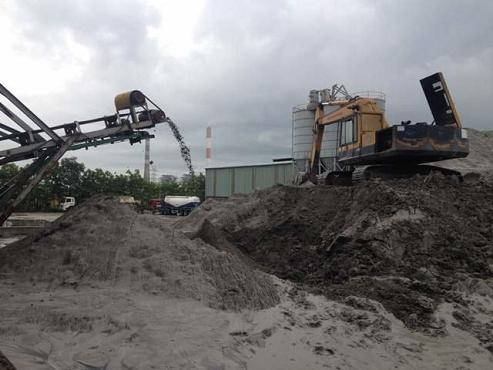
There is a legal corridor to turn waste into production materials. Illustration
To support, the Ministry of Construction has also directed and guided domestic cement and construction material manufacturing enterprises to actively use domestically produced artificial gypsum sources. Specifically, the Ministry of Construction has sent a document to Vicem Corporation, requesting to direct cement factories to seriously carry out research and maximum use of ash, slag, gypsum, and clay replacement. as an additive in cement production...
From a business perspective, Mr. Kieu Van Mat proposed a preferential loan mechanism with low interest rates to lower product prices or VAT exemption for 5-7 years for units that produce and use phosphorus plaster. In addition to the Ministry of Construction directing and encouraging units to use domestically produced phosphorus gypsum to replace imported natural gypsum, Mr. Mat proposed that Hai Phong city provide more land from the DAP Dinh Company's landfill. Vu so that Dinh Vu Plaster Joint Stock Company has enough area to serve production...
However, some units believe that one unit should not have a monopoly on PG waste treatment. The processing technology line needs to be completed and capacity increased to meet actual requirements.
On the other hand, if artificial plaster products meet all 3 elements (quality, economic efficiency, environmental protection), then it is necessary to promote consumption, in the spirit of "Vietnamese people use Vietnamese products" , instead of importing natural gypsum from abroad.
The consumption of artificial gypsum products also needs to be expanded because if cement production alone cannot consume all the amount of gypsum produced annually.
According to Deputy Chairman of the National Assembly's Science, Technology and Environment Committee Le Hong Tinh, balancing the capacity of treatment plants also needs to be taken into account. In particular, avoid machinery in requiring units using artificial plaster in the production of construction materials to reassess the environmental impact. This will make it difficult for businesses.
Deputy Minister Bui Pham Khanh affirmed that the legal basis for handling ash, slag, and gypsum from thermal power plants and chemical fertilizer plants has been very clear, dating back to 2014 with Decision 1696/QD-TTg. Most recently, the Ministry of Construction submitted to the Prime Minister to promulgate Decision 452/QD-TTg; which clearly mentions the responsibilities of each ministry and branch.
The system of standards and regulations related to the treatment of ash, slag, and gypsum as raw materials for construction material production is continuing to be improved. Recently, TCVN 11833:2017 was issued, which is a very important standard in using phosphorus gypsum to produce cement.
Ash, slag and gypsum disposal is a national issue. Project 452/QD-TTg is still new, so in the coming time, relevant ministries, branches and units need to have good coordination in implementing the project's tasks. Along with perfecting technical standards and regulations, researching and applying science and technology for treating ash, slag, and gypsum, it is also necessary to promote propaganda and dissemination of information for the effective implementation of the Project - Deputy Minister Bui Pham Khanh shared.
According to Bnews